




“Ecological gas extinguishing” broadly describes fire extinguishing systems that use inert gases and various chemical compounds as extinguishing agents. These agents are known as “clean extinguishing agents”.
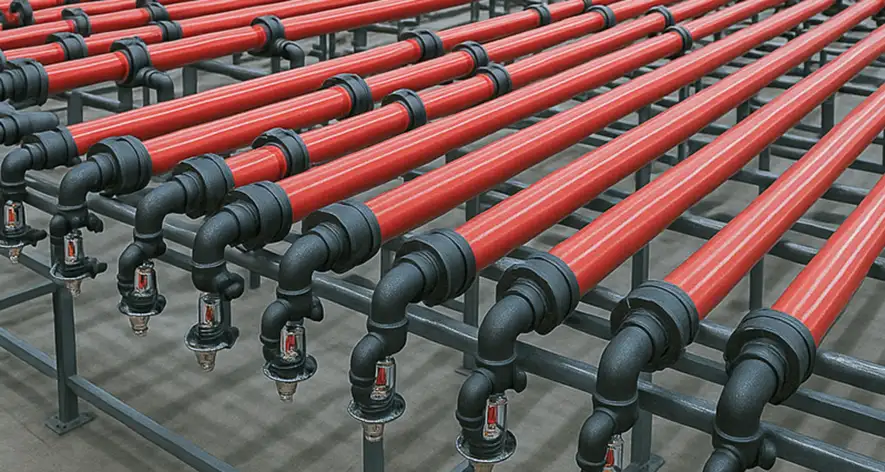
The typical system includes, in addition to the extinguishing agent, the container for the extinguishing agent, valve, smoke detectors as well as the detection system, pipes and specific fittings.
There are four ways in which the extinguishing agent can act to extinguish a fire. Their action is related to the three elements necessary for a fire to break out, namely: heat, fuel and oxygen.
• Reducing or isolating the amount of fuel. Currently, no extinguishing agent has been created for this type of action.
• Reducing the temperature (heat). Representative extinguishing agents for this method: FS 49 C2 (NAF S 227, MH227, FM-200), Novec 1230, pentafluoroethane (NAF S125, ECARO-25).
• Reduction or isolation of oxygen. Representative agents: Argonite/IG-55 (ProInert), CO2 – carbon dioxide, IG-541 Inergen and IG-100 (NN100).
• Interruption of the reactive chain of the above components. Representative agents: FE-13,1,1,1,2,3,3,3-Heptafluoropropane, FE-25, haloalkanes, bromotrifluoromethane, trifluoromethane, NAF P-IV, NAF S-III, NAF S 125, NAF S 227.
INERGEN gas extinguishing systems (IG-541)
INERGEN gas fire extinguishing systems are used in spaces where an electrically non-conductive environment is required and the protected area is usually occupied…
NOVEC 1230 gas extinguishing systems
Novec 1230 liquid is a fluoroketone that offers an important number of advantages for replacing conventional halon. Extinguishing through its cooling effect, Novec 1230 works…
Automatic carbon dioxide fire extinguishing systems
CO2 is a colorless, odorless and non-conductive gas. It extinguishes fires by reducing the oxygen concentration in the space and has a secondary effect of cooling…
